Archive for October, 2006
Bush’s family profits from ‘No Child’ act
By Walter F. Roche Jr.
Times Staff Writer
October 22, 2006
A company headed by President Bush’s brother and partly owned by his parents is benefiting from Republican connections and federal dollars targeted for economically disadvantaged students under the No Child Left Behind Act.
With investments from his parents, George H.W. and Barbara Bush, and other backers, Neil Bush’s company, Ignite! Learning, has placed its products in 40 U.S. school districts and now plans to market internationally.
At least 13 U.S. school districts have used federal funds available through the president’s signature education reform, the No Child Left Behind Act of 2001, to buy Ignite’s portable learning centers at $3,800 apiece.
The law provides federal funds to help school districts better serve disadvantaged students and improve their performance, especially in reading and math.
But Ignite does not offer reading instruction, and its math program will not be available until next year.
The federal Department of Education does not monitor individual school district expenditures under the No Child program, but sets guidelines that the states are expected to enforce, spokesman Chad Colby said.
Ignite executive Tom Deliganis said that “some districts seem to feel OK” about using No Child money for the Ignite purchases, “and others do not.”
Neil Bush said in an e-mail to The Times that Ignite’s program had demonstrated success in improving the test scores of economically disadvantaged children. He also said political influence had not played a role in Ignite’s rapid growth.
“As our business matures in the USA we have plans to expand overseas and to work with many distinguished individuals in Asia, Europe, the Middle East and Africa,” he wrote. “Not one of these associates by the way has ever asked for any access to either of my political brothers, not one White House tour, not one autographed photo, and not one Lincoln bedroom overnight stay.”
Funding laws unclear
Interviews and a review of school district documents obtained under the Freedom of Information Act found that educators and legal experts were sharply divided over whether Ignite’s products were worth their cost or qualified under the No Child law.
The federal law requires schools to show they are meeting educational standards, or risk losing critical funding. If students fail to meet annual performance goals in reading and math tests, schools must supplement their educational offerings with tutoring and other special programs.
Leigh Manasevit, a Washington attorney who specializes in federal education funding, said that districts using the No Child funds to buy products like Ignite’s would have to meet “very strict” student eligibility requirements and ensure that the Ignite services were supplemental to existing programs.
Known as COW, for Curriculum on Wheels (the portable learning centers resemble cows on wheels), Ignite’s product line is geared toward middle school social studies, history and science. The company says it has developed a social studies program that meets curriculum requirements in seven states. Its science program meets requirements in six states.
Most of Ignite’s business has been obtained through sole-source contracts without competitive bidding. Neil Bush has been directly involved in marketing the product.
In addition to federal or state funds, foundations and corporations have helped buy Ignite products. The Washington Times Foundation, backed by the Rev. Sun Myung Moon, head of the South Korea-based Unification Church, has peppered classrooms throughout Virginia with Ignite’s COWs under a $1-million grant.
Oil companies and Middle East interests with long political ties to the Bush family have made similar bequests. Aramco Services Co., an arm of the Saudi-owned oil company, has donated COWs to schools, as have Apache Corp., BP and Shell Oil Co.
Neil Bush said he is a businessman who does not attempt to exert political influence, and he called The Times’ inquiries about his venture — made just before the election — “entirely political.”
Big supporters
Bush’s parents joined Neil as Ignite investors in 1999, according to U.S. Securities and Exchange Commission documents. By 2003, the records show, Neil Bush had raised about $23 million from more than a dozen outside investors, including Mohammed Al Saddah, the head of a Kuwaiti company, and Winston Wong, the head of a Chinese computer firm.
Most recently he signed up Russian fugitive business tycoon Boris A. Berezovsky and Berezovsky’s partner Badri Patarkatsishvili.
Barbara Bush has enthusiastically supported Ignite. In January 2004, she and Neil Bush were guests of honor at a $1,000-atable fundraiser in Oklahoma City organized by a foundation supporting the Western Heights School District. Proceeds were earmarked for the purchase of Ignite products.
Organizer Mary Blankenship Pointer said she planned the event because district students were “utilizing Ignite courseware and experiencing great results. Our students were thriving.”
However, Western Heights school Supt. Joe Kitchens said the district eventually dropped its use of Ignite because it disagreed with changes Ignite had made in its products. “Our interest waned in it,” he said.
The former first lady spurred controversy recently when she contributed to a Hurricane Katrina relief foundation for storm victims who had relocated to Texas. Her donation carried one stipulation: It had to be used by local schools for purchases of COWs.
Texas accounts for 75% of Ignite’s business, which is expanding rapidly in other states, Deliganis said.
The company also has COWs deployed in North Carolina, Virginia, Nevada, California, the District of Columbia, Georgia and Florida, he said.
COWs recently showed up at Hill Classical Middle School in California’s Long Beach Unified School District. A San Jose middle school also bought Ignite’s products but has since closed.
Neil Bush said Ignite has more than 1,700 COWs in classrooms.
Shift in strategy
But Ignite’s educational strategy has changed dramatically, and some are critical of its new approach. Shortly after Ignite was formed in Austin, Texas, in 1999, it bought the software developed by another small Austin firm, Adaptive Learning Technology.
Adaptive Learning founder Mary Schenck-Ross said the software’s interactive lessons allowed teachers “to get away from the mass-treatment approach” to education. When a student typed in a response to a question, the software was designed to react and provide a customized learning path.
“The original concept was to avoid ‘one size fits all.’ That was the point,” said Catherine Malloy, who worked on the software development.
Two years ago, however, Ignite dropped the individualized learning approach. Working with artists and illustrators, it created a large purple COW that could be wheeled from classroom to classroom and plugged in, offering lessons that could be played to a roomful of students.
The COWs enticed students with catchy jingles and videos featuring cartoon characters like Mr. Bighead and Norman Einstein. On Ignite’s website, a collection of teachers endorsed the COW, saying that it eliminated the need for lesson planning. The COW does it for them.
The developers of Adaptive Learning’s software complain that Ignite replaced individualized instruction with a gimmick.
“It breaks my heart what they have done. The concept was totally perverted,” Schenck-Ross said.
Nevertheless, Ignite found many receptive school districts. In Texas, 30 districts use COWs.
In Houston, where Neil Bush and his parents live, the district has used various funding sources to acquire $400,000 in Ignite products. An additional $240,000 in purchases has been authorized in the last six months.
Correspondence obtained by The Times shows that Neil Bush met with top Houston officials, sent e-mails and left voice mail messages urging bigger and faster allocations. An e-mail from a school procurement official to colleagues said Bush had made it clear that he had a “good working relationship” with a school board member.
Another Ignite official asked a Texas state education official to endorse the company. In an e-mail, Neil Bush’s partner Ken Leonard asked Michelle Ungurait, state director of social studies programs, to tell Houston officials her “positive impressions of our content, system and approach.”
Ungurait, identified in another Leonard e-mail as “our good friend” at the state office, told her superiors in response to The Times’ inquiry that she never acted on Leonard’s request.
Leonard said he did not ask Ungurait to do anything that would be improper.
Houston school officials gave Ignite’s products “high” ratings in eight categories and recommended approval.
Some in Houston’s schools question the expenditures, however. Jon Dansby was teaching at Houston’s Fleming Middle School when Ignite products arrived.
“You can’t even get basics like paper and scissors, and we went out and bought them. I just see red,” he said.
In Las Vegas, the schools have approved more than $300,000 in Ignite purchases. Records show the board recommended spending $150,000 in No Child funding on Ignite products.
Sources familiar with the Las Vegas purchases said pressure to buy Ignite products came from Sig Rogich, an influential local figure and prominent Republican whose fundraising of more than $200,000 for President Bush’s 2004 reelection campaign qualified him as a “Bush Ranger.”
Rogich, who chairs a foundation that supports local schools, said he applied no pressure but became interested in COWs after Neil Bush contacted him. Rogich donated $6,000 to purchase two COWs for a middle school named after him.
Christy Falba, the former Clark County school official who oversaw the contracts, said she and her husband attended a dinner with Neil Bush to discuss the products. She said Rogich encouraged the district “to look at the Ignite program” but applied no pressure.
Mixed reviews
Few independent studies have been done to assess the effectiveness of Ignite’s teaching strategies. Neil Bush said the company had gotten “great feedback” from educators and planned to conduct a “major scientifically valid study” to assess the COW’s impact. The results should be in by next summer, he said.
Though Ignite’s products get generally rave reviews from Texas educators, the opinion is not universal.
The Tornillo, Texas, Independent School District no longer uses the Ignite programs it purchased several years ago for $43,000.
“I wouldn’t advise anyone else to use it,” said Supt. Paul Vranish. “Nobody wanted to use it, and the principal who bought it is no longer here.”
Ignite’s website features glowing videotaped testimonials from teachers, administrators, students and parents.
Many of the videos were shot at Del Valle Junior High School near Austin, where school district officials allowed Ignite to film facilities and students.
In the video, a student named India says: “I was feeling bad about my grades. I didn’t know what my teacher was talking about.” The COW changed everything, the girl’s father says on the video.
Lori, a woman identified as India’s teacher, says the child was not paying attention until the COW was brought in.
The woman, however, is not India’s teacher, but Lori Anderson, a former teacher and now Ignite’s marketing director. Ignite says Anderson was simply role-playing.
In return for use of its students and facilities, a district spokeswoman said Ignite donated a free COW. Five others were purchased with district funds.
District spokeswoman Celina Bley acknowledged that regulations bar school officials from endorsing products. But she said that restriction did not apply to the videos.
“It is illegal for individuals to make an endorsement, but this was a districtwide endorsement,” Bley said in an e-mail.
——————————————————————————–
wally.roche@latimes.com
After Pat’s Birthday
Posted on Oct 19, 2006
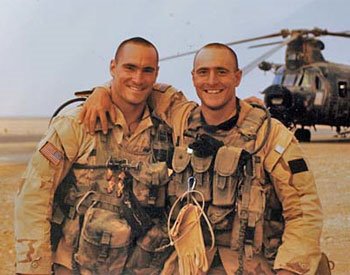
Courtesy of the Tillman Family
Pat Tillman (left) and his brother Kevin stand in front of a Chinook helicopter in Saudi Arabia before their tour of duty as Army Rangers in Iraq in 2003.
By Kevin Tillman
Editor’s note: Kevin Tillman joined the Army with his brother Pat in 2002, and they served together in Iraq and Afghanistan. Pat was killed in Afghanistan on April 22, 2004. Kevin, who was discharged in 2005, has written a powerful, must-read document.
It is Pat’s birthday on November 6, and elections are the day after. It gets me thinking about a conversation I had with Pat before we joined the military. He spoke about the risks with signing the papers. How once we committed, we were at the mercy of the American leadership and the American people. How we could be thrown in a direction not of our volition. How fighting as a soldier would leave us without a voice… until we got out.
Much has happened since we handed over our voice:
Somehow we were sent to invade a nation because it was a direct threat to the American people, or to the world, or harbored terrorists, or was involved in the September 11 attacks, or received weapons-grade uranium from Niger, or had mobile weapons labs, or WMD, or had a need to be liberated, or we needed to establish a democracy, or stop an insurgency, or stop a civil war we created that can’t be called a civil war even though it is. Something like that.
Somehow our elected leaders were subverting international law and humanity by setting up secret prisons around the world, secretly kidnapping people, secretly holding them indefinitely, secretly not charging them with anything, secretly torturing them. Somehow that overt policy of torture became the fault of a few “bad apples” in the military.
Somehow back at home, support for the soldiers meant having a five-year-old kindergartener scribble a picture with crayons and send it overseas, or slapping stickers on cars, or lobbying Congress for an extra pad in a helmet. It’s interesting that a soldier on his third or fourth tour should care about a drawing from a five-year-old; or a faded sticker on a car as his friends die around him; or an extra pad in a helmet, as if it will protect him when an IED throws his vehicle 50 feet into the air as his body comes apart and his skin melts to the seat.
Somehow the more soldiers that die, the more legitimate the illegal invasion becomes.
Somehow American leadership, whose only credit is lying to its people and illegally invading a nation, has been allowed to steal the courage, virtue and honor of its soldiers on the ground.
Somehow those afraid to fight an illegal invasion decades ago are allowed to send soldiers to die for an illegal invasion they started.
Somehow faking character, virtue and strength is tolerated.
Somehow profiting from tragedy and horror is tolerated.
Somehow the death of tens, if not hundreds, of thousands of people is tolerated.
Somehow subversion of the Bill of Rights and The Constitution is tolerated.
Somehow suspension of Habeas Corpus is supposed to keep this country safe.
Somehow torture is tolerated.
Somehow lying is tolerated.
Somehow reason is being discarded for faith, dogma, and nonsense.
Somehow American leadership managed to create a more dangerous world.
Somehow a narrative is more important than reality.
Somehow America has become a country that projects everything that it is not and condemns everything that it is.
Somehow the most reasonable, trusted and respected country in the world has become one of the most irrational, belligerent, feared, and distrusted countries in the world.
Somehow being politically informed, diligent, and skeptical has been replaced by apathy through active ignorance.
Somehow the same incompetent, narcissistic, virtueless, vacuous, malicious criminals are still in charge of this country.
Somehow this is tolerated.
Somehow nobody is accountable for this.
In a democracy, the policy of the leaders is the policy of the people. So don’t be shocked when our grandkids bury much of this generation as traitors to the nation, to the world and to humanity. Most likely, they will come to know that “somehow” was nurtured by fear, insecurity and indifference, leaving the country vulnerable to unchecked, unchallenged parasites.
Luckily this country is still a democracy. People still have a voice. People still can take action. It can start after Pat’s birthday.
Brother and Friend of Pat Tillman,
Kevin Tillman
Pirates of the Mediterranean
By ROBERT HARRIS
Kintbury, England
IN the autumn of 68 B.C. the world’s only military superpower was dealt a profound psychological blow by a daring terrorist attack on its very heart. Rome’s port at Ostia was set on fire, the consular war fleet destroyed, and two prominent senators, together with their bodyguards and staff, kidnapped.
The incident, dramatic though it was, has not attracted much attention from modern historians. But history is mutable. An event that was merely a footnote five years ago has now, in our post-9/11 world, assumed a fresh and ominous significance. For in the panicky aftermath of the attack, the Roman people made decisions that set them on the path to the destruction of their Constitution, their democracy and their liberty. One cannot help wondering if history is repeating itself.
Consider the parallels. The perpetrators of this spectacular assault were not in the pay of any foreign power: no nation would have dared to attack Rome so provocatively. They were, rather, the disaffected of the earth: “The ruined men of all nations,” in the words of the great 19th-century German historian Theodor Mommsen, “a piratical state with a peculiar esprit de corps.”
Like Al Qaeda, these pirates were loosely organized, but able to spread a disproportionate amount of fear among citizens who had believed themselves immune from attack. To quote Mommsen again: “The Latin husbandman, the traveler on the Appian highway, the genteel bathing visitor at the terrestrial paradise of Baiae were no longer secure of their property or their life for a single moment.”
What was to be done? Over the preceding centuries, the Constitution of ancient Rome had developed an intricate series of checks and balances intended to prevent the concentration of power in the hands of a single individual. The consulship, elected annually, was jointly held by two men. Military commands were of limited duration and subject to regular renewal. Ordinary citizens were accustomed to a remarkable degree of liberty: the cry of “Civis Romanus sum” — “I am a Roman citizen” — was a guarantee of safety throughout the world.
But such was the panic that ensued after Ostia that the people were willing to compromise these rights. The greatest soldier in Rome, the 38-year-old Gnaeus Pompeius Magnus (better known to posterity as Pompey the Great) arranged for a lieutenant of his, the tribune Aulus Gabinius, to rise in the Roman Forum and propose an astonishing new law.
“Pompey was to be given not only the supreme naval command but what amounted in fact to an absolute authority and uncontrolled power over everyone,” the Greek historian Plutarch wrote. “There were not many places in the Roman world that were not included within these limits.”
Pompey eventually received almost the entire contents of the Roman Treasury — 144 million sesterces — to pay for his “war on terror,” which included building a fleet of 500 ships and raising an army of 120,000 infantry and 5,000 cavalry. Such an accumulation of power was unprecedented, and there was literally a riot in the Senate when the bill was debated.
Nevertheless, at a tumultuous mass meeting in the center of Rome, Pompey’s opponents were cowed into submission, the Lex Gabinia passed (illegally), and he was given his power. In the end, once he put to sea, it took less than three months to sweep the pirates from the entire Mediterranean. Even allowing for Pompey’s genius as a military strategist, the suspicion arises that if the pirates could be defeated so swiftly, they could hardly have been such a grievous threat in the first place.
But it was too late to raise such questions. By the oldest trick in the political book — the whipping up of a panic, in which any dissenting voice could be dismissed as “soft” or even “traitorous” — powers had been ceded by the people that would never be returned. Pompey stayed in the Middle East for six years, establishing puppet regimes throughout the region, and turning himself into the richest man in the empire.
Those of us who are not Americans can only look on in wonder at the similar ease with which the ancient rights and liberties of the individual are being surrendered in the United States in the wake of 9/11. The vote by the Senate on Thursday to suspend the right of habeas corpus for terrorism detainees, denying them their right to challenge their detention in court; the careful wording about torture, which forbids only the inducement of “serious” physical and mental suffering to obtain information; the admissibility of evidence obtained in the United States without a search warrant; the licensing of the president to declare a legal resident of the United States an enemy combatant — all this represents an historic shift in the balance of power between the citizen and the executive.
An intelligent, skeptical American would no doubt scoff at the thought that what has happened since 9/11 could presage the destruction of a centuries-old constitution; but then, I suppose, an intelligent, skeptical Roman in 68 B.C. might well have done the same.
In truth, however, the Lex Gabinia was the beginning of the end of the Roman republic. It set a precedent. Less than a decade later, Julius Caesar — the only man, according to Plutarch, who spoke out in favor of Pompey’s special command during the Senate debate — was awarded similar, extended military sovereignty in Gaul. Previously, the state, through the Senate, largely had direction of its armed forces; now the armed forces began to assume direction of the state.
It also brought a flood of money into an electoral system that had been designed for a simpler, non-imperial era. Caesar, like Pompey, with all the resources of Gaul at his disposal, became immensely wealthy, and used his treasure to fund his own political faction. Henceforth, the result of elections was determined largely by which candidate had the most money to bribe the electorate. In 49 B.C., the system collapsed completely, Caesar crossed the Rubicon — and the rest, as they say, is ancient history.
It may be that the Roman republic was doomed in any case. But the disproportionate reaction to the raid on Ostia unquestionably hastened the process, weakening the restraints on military adventurism and corrupting the political process. It was to be more than 1,800 years before anything remotely comparable to Rome’s democracy — imperfect though it was — rose again.
The Lex Gabinia was a classic illustration of the law of unintended consequences: it fatally subverted the institution it was supposed to protect. Let us hope that vote in the United States Senate does not have the same result.
Robert Harris is the author, most recently, of “Imperium: A Novel of Ancient Rome.”

 Ma Hamatzav? (Was' Up?)