Is There A Jewish Mainline?
Yesterday’s USA Today included an article entitled, “Some Protestant churches feeling ‘mainline’ again,” contending that it’s not just conservative, evangelical churches that are thriving but that many mainline Protestant congregations are alive and well. The “mainline” here refers to the Episcopal, Presbyterian, Disciples of Christ, United Church of Christ, United Methodist, and Lutheran denominations. Most of the press around these denominations has predicted the slow demise of the mainline from the religious landscape of American Christianity.
Not so, says Diana Butler-Bass in her new book, Christianity for the Rest of Us: How the Neighborhood Church is Transforming the Faith. Along with her two previous books, The Practicing Congregation: Imagining a New Old Church and From Nomads to Pilgrims: Stories from Practicing Congregations, her research found that there are mainline churches that are doing well, and many are thriving and growing.
So, what does this have to do with American Judaism? We could learn a lot from Diana’s research. Bass makes a distinction between programs and practices. The congregations she studied are able to identify those things they do that were irrelevant or lost their meaning. Instead of throwing these away, Bass talks of “retraditionalizing” these practices. I’m reminded of Larry Hoffman’s distinction between ritual and ritualization in The Art of Public Prayer. Bass’s research found that mainline churchgoers crave ritual and ancient practice. But, they also want these presented in ways that are relevant and meaningful to their contemporary lives. So while one Episcopal church chants Gregorian melodies, they also offer Café St. Mark – a free breakfast buffet for all, member and visitor, as a way of offering hospitality and forming community.
One Lutheran official stated of mainline Protestantism, “We got lazy…” Sociologist of religion Barry Kosmin says, “The mainline is never going to be the dominant cultural group again.”
Where is American “mainline” Judaism in comparison? There is already talk that Judaism is in a post denomination/movement period. Steven M. Cohen’s forthcoming S3K Report for the S3K Synagogue Studies Institute on movement affiliation may say otherwise. Larry Hoffman says that “post-denominationalism is a ‘myth’ and that denominations are still very important.” I would contend that the movements are not important themselves; it’s the identity that synagogues derive from their affiliation. However, I think we’re in the midst of our “lazy period.” If synagogues (and the movements) don’t start the process of retraditionalizing, we will have our own version of mainline decline.
Bass says of these practicing, revitalized churches, they “have a beautiful world where they are enacting service, doing justice, learning to pray and caring for one another.” Isn’t it interesting how this parallels the edict in Pirke Avoth, “The world rests on three foundations: study, service, and benevolence”? Judaism offers the prescription for vital synagogue communities. Maybe it’s time for us to borrow it back from our Christian brothers and sisters?!
(this post also appears at http://synagogue3000.org/synablog/?p=74)
Bush’s family profits from ‘No Child’ act
By Walter F. Roche Jr.
Times Staff Writer
October 22, 2006
A company headed by President Bush’s brother and partly owned by his parents is benefiting from Republican connections and federal dollars targeted for economically disadvantaged students under the No Child Left Behind Act.
With investments from his parents, George H.W. and Barbara Bush, and other backers, Neil Bush’s company, Ignite! Learning, has placed its products in 40 U.S. school districts and now plans to market internationally.
At least 13 U.S. school districts have used federal funds available through the president’s signature education reform, the No Child Left Behind Act of 2001, to buy Ignite’s portable learning centers at $3,800 apiece.
The law provides federal funds to help school districts better serve disadvantaged students and improve their performance, especially in reading and math.
But Ignite does not offer reading instruction, and its math program will not be available until next year.
The federal Department of Education does not monitor individual school district expenditures under the No Child program, but sets guidelines that the states are expected to enforce, spokesman Chad Colby said.
Ignite executive Tom Deliganis said that “some districts seem to feel OK” about using No Child money for the Ignite purchases, “and others do not.”
Neil Bush said in an e-mail to The Times that Ignite’s program had demonstrated success in improving the test scores of economically disadvantaged children. He also said political influence had not played a role in Ignite’s rapid growth.
“As our business matures in the USA we have plans to expand overseas and to work with many distinguished individuals in Asia, Europe, the Middle East and Africa,” he wrote. “Not one of these associates by the way has ever asked for any access to either of my political brothers, not one White House tour, not one autographed photo, and not one Lincoln bedroom overnight stay.”
Funding laws unclear
Interviews and a review of school district documents obtained under the Freedom of Information Act found that educators and legal experts were sharply divided over whether Ignite’s products were worth their cost or qualified under the No Child law.
The federal law requires schools to show they are meeting educational standards, or risk losing critical funding. If students fail to meet annual performance goals in reading and math tests, schools must supplement their educational offerings with tutoring and other special programs.
Leigh Manasevit, a Washington attorney who specializes in federal education funding, said that districts using the No Child funds to buy products like Ignite’s would have to meet “very strict” student eligibility requirements and ensure that the Ignite services were supplemental to existing programs.
Known as COW, for Curriculum on Wheels (the portable learning centers resemble cows on wheels), Ignite’s product line is geared toward middle school social studies, history and science. The company says it has developed a social studies program that meets curriculum requirements in seven states. Its science program meets requirements in six states.
Most of Ignite’s business has been obtained through sole-source contracts without competitive bidding. Neil Bush has been directly involved in marketing the product.
In addition to federal or state funds, foundations and corporations have helped buy Ignite products. The Washington Times Foundation, backed by the Rev. Sun Myung Moon, head of the South Korea-based Unification Church, has peppered classrooms throughout Virginia with Ignite’s COWs under a $1-million grant.
Oil companies and Middle East interests with long political ties to the Bush family have made similar bequests. Aramco Services Co., an arm of the Saudi-owned oil company, has donated COWs to schools, as have Apache Corp., BP and Shell Oil Co.
Neil Bush said he is a businessman who does not attempt to exert political influence, and he called The Times’ inquiries about his venture — made just before the election — “entirely political.”
Big supporters
Bush’s parents joined Neil as Ignite investors in 1999, according to U.S. Securities and Exchange Commission documents. By 2003, the records show, Neil Bush had raised about $23 million from more than a dozen outside investors, including Mohammed Al Saddah, the head of a Kuwaiti company, and Winston Wong, the head of a Chinese computer firm.
Most recently he signed up Russian fugitive business tycoon Boris A. Berezovsky and Berezovsky’s partner Badri Patarkatsishvili.
Barbara Bush has enthusiastically supported Ignite. In January 2004, she and Neil Bush were guests of honor at a $1,000-atable fundraiser in Oklahoma City organized by a foundation supporting the Western Heights School District. Proceeds were earmarked for the purchase of Ignite products.
Organizer Mary Blankenship Pointer said she planned the event because district students were “utilizing Ignite courseware and experiencing great results. Our students were thriving.”
However, Western Heights school Supt. Joe Kitchens said the district eventually dropped its use of Ignite because it disagreed with changes Ignite had made in its products. “Our interest waned in it,” he said.
The former first lady spurred controversy recently when she contributed to a Hurricane Katrina relief foundation for storm victims who had relocated to Texas. Her donation carried one stipulation: It had to be used by local schools for purchases of COWs.
Texas accounts for 75% of Ignite’s business, which is expanding rapidly in other states, Deliganis said.
The company also has COWs deployed in North Carolina, Virginia, Nevada, California, the District of Columbia, Georgia and Florida, he said.
COWs recently showed up at Hill Classical Middle School in California’s Long Beach Unified School District. A San Jose middle school also bought Ignite’s products but has since closed.
Neil Bush said Ignite has more than 1,700 COWs in classrooms.
Shift in strategy
But Ignite’s educational strategy has changed dramatically, and some are critical of its new approach. Shortly after Ignite was formed in Austin, Texas, in 1999, it bought the software developed by another small Austin firm, Adaptive Learning Technology.
Adaptive Learning founder Mary Schenck-Ross said the software’s interactive lessons allowed teachers “to get away from the mass-treatment approach” to education. When a student typed in a response to a question, the software was designed to react and provide a customized learning path.
“The original concept was to avoid ‘one size fits all.’ That was the point,” said Catherine Malloy, who worked on the software development.
Two years ago, however, Ignite dropped the individualized learning approach. Working with artists and illustrators, it created a large purple COW that could be wheeled from classroom to classroom and plugged in, offering lessons that could be played to a roomful of students.
The COWs enticed students with catchy jingles and videos featuring cartoon characters like Mr. Bighead and Norman Einstein. On Ignite’s website, a collection of teachers endorsed the COW, saying that it eliminated the need for lesson planning. The COW does it for them.
The developers of Adaptive Learning’s software complain that Ignite replaced individualized instruction with a gimmick.
“It breaks my heart what they have done. The concept was totally perverted,” Schenck-Ross said.
Nevertheless, Ignite found many receptive school districts. In Texas, 30 districts use COWs.
In Houston, where Neil Bush and his parents live, the district has used various funding sources to acquire $400,000 in Ignite products. An additional $240,000 in purchases has been authorized in the last six months.
Correspondence obtained by The Times shows that Neil Bush met with top Houston officials, sent e-mails and left voice mail messages urging bigger and faster allocations. An e-mail from a school procurement official to colleagues said Bush had made it clear that he had a “good working relationship” with a school board member.
Another Ignite official asked a Texas state education official to endorse the company. In an e-mail, Neil Bush’s partner Ken Leonard asked Michelle Ungurait, state director of social studies programs, to tell Houston officials her “positive impressions of our content, system and approach.”
Ungurait, identified in another Leonard e-mail as “our good friend” at the state office, told her superiors in response to The Times’ inquiry that she never acted on Leonard’s request.
Leonard said he did not ask Ungurait to do anything that would be improper.
Houston school officials gave Ignite’s products “high” ratings in eight categories and recommended approval.
Some in Houston’s schools question the expenditures, however. Jon Dansby was teaching at Houston’s Fleming Middle School when Ignite products arrived.
“You can’t even get basics like paper and scissors, and we went out and bought them. I just see red,” he said.
In Las Vegas, the schools have approved more than $300,000 in Ignite purchases. Records show the board recommended spending $150,000 in No Child funding on Ignite products.
Sources familiar with the Las Vegas purchases said pressure to buy Ignite products came from Sig Rogich, an influential local figure and prominent Republican whose fundraising of more than $200,000 for President Bush’s 2004 reelection campaign qualified him as a “Bush Ranger.”
Rogich, who chairs a foundation that supports local schools, said he applied no pressure but became interested in COWs after Neil Bush contacted him. Rogich donated $6,000 to purchase two COWs for a middle school named after him.
Christy Falba, the former Clark County school official who oversaw the contracts, said she and her husband attended a dinner with Neil Bush to discuss the products. She said Rogich encouraged the district “to look at the Ignite program” but applied no pressure.
Mixed reviews
Few independent studies have been done to assess the effectiveness of Ignite’s teaching strategies. Neil Bush said the company had gotten “great feedback” from educators and planned to conduct a “major scientifically valid study” to assess the COW’s impact. The results should be in by next summer, he said.
Though Ignite’s products get generally rave reviews from Texas educators, the opinion is not universal.
The Tornillo, Texas, Independent School District no longer uses the Ignite programs it purchased several years ago for $43,000.
“I wouldn’t advise anyone else to use it,” said Supt. Paul Vranish. “Nobody wanted to use it, and the principal who bought it is no longer here.”
Ignite’s website features glowing videotaped testimonials from teachers, administrators, students and parents.
Many of the videos were shot at Del Valle Junior High School near Austin, where school district officials allowed Ignite to film facilities and students.
In the video, a student named India says: “I was feeling bad about my grades. I didn’t know what my teacher was talking about.” The COW changed everything, the girl’s father says on the video.
Lori, a woman identified as India’s teacher, says the child was not paying attention until the COW was brought in.
The woman, however, is not India’s teacher, but Lori Anderson, a former teacher and now Ignite’s marketing director. Ignite says Anderson was simply role-playing.
In return for use of its students and facilities, a district spokeswoman said Ignite donated a free COW. Five others were purchased with district funds.
District spokeswoman Celina Bley acknowledged that regulations bar school officials from endorsing products. But she said that restriction did not apply to the videos.
“It is illegal for individuals to make an endorsement, but this was a districtwide endorsement,” Bley said in an e-mail.
——————————————————————————–
wally.roche@latimes.com
After Pat’s Birthday
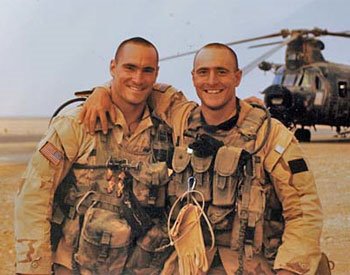
Posted on Oct 19, 2006
Courtesy of the Tillman Family
Pat Tillman (left) and his brother Kevin stand in front of a Chinook helicopter in Saudi Arabia before their tour of duty as Army Rangers in Iraq in 2003.
By Kevin Tillman
Editor’s note: Kevin Tillman joined the Army with his brother Pat in 2002, and they served together in Iraq and Afghanistan. Pat was killed in Afghanistan on April 22, 2004. Kevin, who was discharged in 2005, has written a powerful, must-read document.
It is Pat’s birthday on November 6, and elections are the day after. It gets me thinking about a conversation I had with Pat before we joined the military. He spoke about the risks with signing the papers. How once we committed, we were at the mercy of the American leadership and the American people. How we could be thrown in a direction not of our volition. How fighting as a soldier would leave us without a voice… until we got out.
Much has happened since we handed over our voice:
Somehow we were sent to invade a nation because it was a direct threat to the American people, or to the world, or harbored terrorists, or was involved in the September 11 attacks, or received weapons-grade uranium from Niger, or had mobile weapons labs, or WMD, or had a need to be liberated, or we needed to establish a democracy, or stop an insurgency, or stop a civil war we created that can’t be called a civil war even though it is. Something like that.
Somehow our elected leaders were subverting international law and humanity by setting up secret prisons around the world, secretly kidnapping people, secretly holding them indefinitely, secretly not charging them with anything, secretly torturing them. Somehow that overt policy of torture became the fault of a few “bad apples” in the military.
Somehow back at home, support for the soldiers meant having a five-year-old kindergartener scribble a picture with crayons and send it overseas, or slapping stickers on cars, or lobbying Congress for an extra pad in a helmet. It’s interesting that a soldier on his third or fourth tour should care about a drawing from a five-year-old; or a faded sticker on a car as his friends die around him; or an extra pad in a helmet, as if it will protect him when an IED throws his vehicle 50 feet into the air as his body comes apart and his skin melts to the seat.
Somehow the more soldiers that die, the more legitimate the illegal invasion becomes.
Somehow American leadership, whose only credit is lying to its people and illegally invading a nation, has been allowed to steal the courage, virtue and honor of its soldiers on the ground.
Somehow those afraid to fight an illegal invasion decades ago are allowed to send soldiers to die for an illegal invasion they started.
Somehow faking character, virtue and strength is tolerated.
Somehow profiting from tragedy and horror is tolerated.
Somehow the death of tens, if not hundreds, of thousands of people is tolerated.
Somehow subversion of the Bill of Rights and The Constitution is tolerated.
Somehow suspension of Habeas Corpus is supposed to keep this country safe.
Somehow torture is tolerated.
Somehow lying is tolerated.
Somehow reason is being discarded for faith, dogma, and nonsense.
Somehow American leadership managed to create a more dangerous world.
Somehow a narrative is more important than reality.
Somehow America has become a country that projects everything that it is not and condemns everything that it is.
Somehow the most reasonable, trusted and respected country in the world has become one of the most irrational, belligerent, feared, and distrusted countries in the world.
Somehow being politically informed, diligent, and skeptical has been replaced by apathy through active ignorance.
Somehow the same incompetent, narcissistic, virtueless, vacuous, malicious criminals are still in charge of this country.
Somehow this is tolerated.
Somehow nobody is accountable for this.
In a democracy, the policy of the leaders is the policy of the people. So don’t be shocked when our grandkids bury much of this generation as traitors to the nation, to the world and to humanity. Most likely, they will come to know that “somehow” was nurtured by fear, insecurity and indifference, leaving the country vulnerable to unchecked, unchallenged parasites.
Luckily this country is still a democracy. People still have a voice. People still can take action. It can start after Pat’s birthday.
Brother and Friend of Pat Tillman,
Kevin Tillman
Pirates of the Mediterranean
By ROBERT HARRIS
Kintbury, England
IN the autumn of 68 B.C. the world’s only military superpower was dealt a profound psychological blow by a daring terrorist attack on its very heart. Rome’s port at Ostia was set on fire, the consular war fleet destroyed, and two prominent senators, together with their bodyguards and staff, kidnapped.
The incident, dramatic though it was, has not attracted much attention from modern historians. But history is mutable. An event that was merely a footnote five years ago has now, in our post-9/11 world, assumed a fresh and ominous significance. For in the panicky aftermath of the attack, the Roman people made decisions that set them on the path to the destruction of their Constitution, their democracy and their liberty. One cannot help wondering if history is repeating itself.
Consider the parallels. The perpetrators of this spectacular assault were not in the pay of any foreign power: no nation would have dared to attack Rome so provocatively. They were, rather, the disaffected of the earth: “The ruined men of all nations,” in the words of the great 19th-century German historian Theodor Mommsen, “a piratical state with a peculiar esprit de corps.”
Like Al Qaeda, these pirates were loosely organized, but able to spread a disproportionate amount of fear among citizens who had believed themselves immune from attack. To quote Mommsen again: “The Latin husbandman, the traveler on the Appian highway, the genteel bathing visitor at the terrestrial paradise of Baiae were no longer secure of their property or their life for a single moment.”
What was to be done? Over the preceding centuries, the Constitution of ancient Rome had developed an intricate series of checks and balances intended to prevent the concentration of power in the hands of a single individual. The consulship, elected annually, was jointly held by two men. Military commands were of limited duration and subject to regular renewal. Ordinary citizens were accustomed to a remarkable degree of liberty: the cry of “Civis Romanus sum” — “I am a Roman citizen” — was a guarantee of safety throughout the world.
But such was the panic that ensued after Ostia that the people were willing to compromise these rights. The greatest soldier in Rome, the 38-year-old Gnaeus Pompeius Magnus (better known to posterity as Pompey the Great) arranged for a lieutenant of his, the tribune Aulus Gabinius, to rise in the Roman Forum and propose an astonishing new law.
“Pompey was to be given not only the supreme naval command but what amounted in fact to an absolute authority and uncontrolled power over everyone,” the Greek historian Plutarch wrote. “There were not many places in the Roman world that were not included within these limits.”
Pompey eventually received almost the entire contents of the Roman Treasury — 144 million sesterces — to pay for his “war on terror,” which included building a fleet of 500 ships and raising an army of 120,000 infantry and 5,000 cavalry. Such an accumulation of power was unprecedented, and there was literally a riot in the Senate when the bill was debated.
Nevertheless, at a tumultuous mass meeting in the center of Rome, Pompey’s opponents were cowed into submission, the Lex Gabinia passed (illegally), and he was given his power. In the end, once he put to sea, it took less than three months to sweep the pirates from the entire Mediterranean. Even allowing for Pompey’s genius as a military strategist, the suspicion arises that if the pirates could be defeated so swiftly, they could hardly have been such a grievous threat in the first place.
But it was too late to raise such questions. By the oldest trick in the political book — the whipping up of a panic, in which any dissenting voice could be dismissed as “soft” or even “traitorous” — powers had been ceded by the people that would never be returned. Pompey stayed in the Middle East for six years, establishing puppet regimes throughout the region, and turning himself into the richest man in the empire.
Those of us who are not Americans can only look on in wonder at the similar ease with which the ancient rights and liberties of the individual are being surrendered in the United States in the wake of 9/11. The vote by the Senate on Thursday to suspend the right of habeas corpus for terrorism detainees, denying them their right to challenge their detention in court; the careful wording about torture, which forbids only the inducement of “serious” physical and mental suffering to obtain information; the admissibility of evidence obtained in the United States without a search warrant; the licensing of the president to declare a legal resident of the United States an enemy combatant — all this represents an historic shift in the balance of power between the citizen and the executive.
An intelligent, skeptical American would no doubt scoff at the thought that what has happened since 9/11 could presage the destruction of a centuries-old constitution; but then, I suppose, an intelligent, skeptical Roman in 68 B.C. might well have done the same.
In truth, however, the Lex Gabinia was the beginning of the end of the Roman republic. It set a precedent. Less than a decade later, Julius Caesar — the only man, according to Plutarch, who spoke out in favor of Pompey’s special command during the Senate debate — was awarded similar, extended military sovereignty in Gaul. Previously, the state, through the Senate, largely had direction of its armed forces; now the armed forces began to assume direction of the state.
It also brought a flood of money into an electoral system that had been designed for a simpler, non-imperial era. Caesar, like Pompey, with all the resources of Gaul at his disposal, became immensely wealthy, and used his treasure to fund his own political faction. Henceforth, the result of elections was determined largely by which candidate had the most money to bribe the electorate. In 49 B.C., the system collapsed completely, Caesar crossed the Rubicon — and the rest, as they say, is ancient history.
It may be that the Roman republic was doomed in any case. But the disproportionate reaction to the raid on Ostia unquestionably hastened the process, weakening the restraints on military adventurism and corrupting the political process. It was to be more than 1,800 years before anything remotely comparable to Rome’s democracy — imperfect though it was — rose again.
The Lex Gabinia was a classic illustration of the law of unintended consequences: it fatally subverted the institution it was supposed to protect. Let us hope that vote in the United States Senate does not have the same result.
Robert Harris is the author, most recently, of “Imperium: A Novel of Ancient Rome.”
America’s New Fascism
From Keith Olbermann:
The man who sees absolutes, where all other men see nuances and shades of meaning, is either a prophet, or a quack.
Donald H. Rumsfeld is not a prophet.
Mr. Rumsfeld’s remarkable speech to the American Legion yesterday demands the deep analysis–and the sober contemplation–of every American.
For it did not merely serve to impugn the morality or intelligence — indeed, the loyalty — of the majority of Americans who oppose the transient occupants of the highest offices in the land. Worse, still, it credits those same transient occupants — our employees — with a total omniscience; a total omniscience which neither common sense, nor this administration’s track record at home or abroad, suggests they deserve.
Dissent and disagreement with government is the life’s blood of human freedom; and not merely because it is the first roadblock against the kind of tyranny the men Mr. Rumsfeld likes to think of as “his” troops still fight, this very evening, in Iraq.
It is also essential. Because just every once in awhile it is right and the power to which it speaks, is wrong.
In a small irony, however, Mr. Rumsfeld’s speechwriter was adroit in invoking the memory of the appeasement of the Nazis. For in their time, there was another government faced with true peril–with a growing evil–powerful and remorseless.
That government, like Mr. Rumsfeld’s, had a monopoly on all the facts. It, too, had the “secret information.” It alone had the true picture of the threat. It too dismissed and insulted its critics in terms like Mr. Rumsfeld’s — questioning their intellect and their morality.
That government was England’s, in the 1930’s.
It knew Hitler posed no true threat to Europe, let alone England.
It knew Germany was not re-arming, in violation of all treaties and accords.
It knew that the hard evidence it received, which contradicted its own policies, its own conclusions — its own omniscience — needed to be dismissed.
The English government of Neville Chamberlain already knew the truth.
Most relevant of all — it “knew” that its staunchest critics needed to be marginalized and isolated. In fact, it portrayed the foremost of them as a blood-thirsty war-monger who was, if not truly senile, at best morally or intellectually confused.
That critic’s name was Winston Churchill.
Sadly, we have no Winston Churchills evident among us this evening. We have only Donald Rumsfelds, demonizing disagreement, the way Neville Chamberlain demonized Winston Churchill.
History — and 163 million pounds of Luftwaffe bombs over England — have taught us that all Mr. Chamberlain had was his certainty — and his own confusion. A confusion that suggested that the office can not only make the man, but that the office can also make the facts.
Thus, did Mr. Rumsfeld make an apt historical analogy.
Excepting the fact, that he has the battery plugged in backwards.
His government, absolute — and exclusive — in its knowledge, is not the modern version of the one which stood up to the Nazis.
It is the modern version of the government of Neville Chamberlain.
But back to today’s Omniscient ones.
That, about which Mr. Rumsfeld is confused is simply this: This is a Democracy. Still. Sometimes just barely.
And, as such, all voices count — not just his.
Had he or his president perhaps proven any of their prior claims of omniscience — about Osama Bin Laden’s plans five years ago, about Saddam Hussein’s weapons four years ago, about Hurricane Katrina’s impact one year ago — we all might be able to swallow hard, and accept their “omniscience” as a bearable, even useful recipe, of fact, plus ego.
But, to date, this government has proved little besides its own arrogance, and its own hubris.
Mr. Rumsfeld is also personally confused, morally or intellectually, about his own standing in this matter. From Iraq to Katrina, to the entire “Fog of Fear” which continues to envelop this nation, he, Mr. Bush, Mr. Cheney, and their cronies have — inadvertently or intentionally — profited and benefited, both personally, and politically.
And yet he can stand up, in public, and question the morality and the intellect of those of us who dare ask just for the receipt for the Emporer’s New Clothes?
In what country was Mr. Rumsfeld raised? As a child, of whose heroism did he read? On what side of the battle for freedom did he dream one day to fight? With what country has he confused the United States of America?
The confusion we — as its citizens– must now address, is stark and forbidding.
But variations of it have faced our forefathers, when men like Nixon and McCarthy and Curtis LeMay have darkened our skies and obscured our flag. Note — with hope in your heart — that those earlier Americans always found their way to the light, and we can, too.
The confusion is about whether this Secretary of Defense, and this administration, are in fact now accomplishing what they claim the terrorists seek: The destruction of our freedoms, the very ones for which the same veterans Mr. Rumsfeld addressed yesterday in Salt Lake City, so valiantly fought.
And about Mr. Rumsfeld’s other main assertion, that this country faces a “new type of fascism.”
As he was correct to remind us how a government that knew everything could get everything wrong, so too was he right when he said that — though probably not in the way he thought he meant it.
This country faces a new type of fascism – indeed.
Although I presumptuously use his sign-off each night, in feeble tribute, I have utterly no claim to the words of the exemplary journalist Edward R. Murrow.
But never in the trial of a thousand years of writing could I come close to matching how he phrased a warning to an earlier generation of us, at a time when other politicians thought they (and they alone) knew everything, and branded those who disagreed: “confused” or “immoral.”
Thus, forgive me, for reading Murrow, in full:
“We must not confuse dissent with disloyalty,” he said, in 1954. “We must remember always that accusation is not proof, and that conviction depends upon evidence and due process of law.
“We will not walk in fear, one of another. We will not be driven by fear into an age of unreason, if we dig deep in our history and our doctrine, and remember that we are not descended from fearful men, not from men who feared to write, to speak, to associate, and to defend causes that were for the moment unpopular.”
And so good night, and good luck.
‘Kana collapse was hours after attack’
by Yaakov Katz, Jerusalem Post
In the deadliest attack since Israel started its offensive against Hizbullah 19 days ago, 57 civilians – most of them children – were killed on Sunday in a building in the southern Lebanese village of Kafr Kana, apparently as a result of an IAF missile strike.
While the entire Israeli political echelon expressed regret for the results of the strike, Air Force Chief of Staff Brig.-Gen. Amir Eshel said Sunday night that the three-story building had been struck by the missiles a little after midnight and that it only collapsed seven hours later, at close to 7 a.m.
Eshel refrained from specifying what had caused the structure to collapse seven hours after it was hit, but senior IAF officers said Sunday night that the explosion could have been caused by an unexploded missile or by a Hizbullah-planted explosive device.
“It could be that there was something in the building that caused the explosion,” Eshel said.
Eshel said that close to 150 Katyusha rockets had been fired from the Lebanese village over the past 20 days. Hizbullah had hidden rocket launchers, Eshel said, in civilian buildings in the village. Video footage he presented at a press conference in Tel Aviv Sunday night showed rocket launchers being driven into the village following attacks on northern Israel.
The dead were old people, women and children from four families whom residents said had gathered to spend the night on the ground floor, where they felt they were safe from Israeli attacks. The bodies of at least 27 children were found in the rubble, said Abu Shadi Jradi, a civil defense official at the scene.
In 1996, Israel was forced to suspend Operation Grapes of Wrath against Hizbullah after IDF artillery shells killed more than 100 civilians seeking refuge in a UN building in the village.
A high-ranking IAF officer said the IDF had warned Kafr Kana residents to evacuate the village in anticipation of airstrikes on Katyusha launchers. The officer said the air force had been targeting the village for the past three days and that on Saturday night it struck 10 targets there. He said the building hit Sunday was chosen as a target after intelligence indicated that Hizbullah guerrillas were hiding inside, where Katyusha rockets and launchers were also hidden.
“We warned the residents that we would be attacking there,” the high-ranking officer said. “We work under the assumption that the villages are empty and that whoever is there is affiliated with Hizbullah.”
The IAF did attack targets in the village at 7 a.m. Sunday, Eshel said, but these buildings were 500 meters away from the building where the civilians were killed.
Prime Minister Ehud Olmert expressed deep regret for the harm inflicted on the civilians in Kafr Kana.
“I, along with Israel and the IDF, express deep regret at the death of civilians in Kafr Kana,” said Olmert. “There is nothing further from our intent than when we hit civilians – everyone understands that. When we do harm civilians, the whole world recognizes that it is an exceptional case that does not characterize us.”
Olmert said the area was a focal point for the firing of Katyusha rockets at Kiryat Shmona and Afula. He said that from the outset of the current violence, “hundreds of rockets have been fired from the Kana area.”
Defense Minister Amir Peretz also profoundly regretted the fatal strike, saying, “This is a tragic incident that is the result of a war against Hizbullah, which is operating from civilian areas and knows full well that by so doing it is endangering lives.” The defense minister ordered the IDF to conduct a thorough investigation into the incident.
IDF Chief of General Staff Lt.-Gen. Dan Halutz also expressed sorrow over the loss of innocent life. “We were operating in a place from where Katyushas are being fired and we distributed notices to residents. Unfortunately, people who assembled in the area, whom we were unaware of, were harmed,” said Halutz.
Nevertheless, Halutz said, the IDF would continue to fight to protect northern Israel and to bring calm to the region. “The terrorist organizations are taking cover among populated areas,” he said. “We will continue to fight, causing the minimum harm to civilians.”
Lebanese Prime Minister Fuad Saniora demanded an immediate and unconditional cease-fire and an investigation into the attack.
US Secretary of State Condoleezza Rice said she had called Saniora to say she would be postponing a visit to Beirut scheduled for Sunday and that she had work to do in Jerusalem to end the fighting. “We are also pushing for an urgent end to the current hostilities, but the views of the parties on how to achieve this are different,” she said.
AP contributed to the report.
Volunteer or Indentured Servant?
Congregation Beth-Israel has just finished a successful fundraising campaign. The campaign’s purpose was to purchase playground equipment for the children of residents of a local battered woman’s shelter – a great cause and an example of tikkun olam in action. Not only did Beth-Israel raise enough money to purchase the equipment and its installation, they raised enough to set aside a fund for future maintenance of the playground. The campaign was a success.
The major players in this campaign were four active members – Ruthie, Arlene, Joan and Lizzie. All four women are active sisterhood members. Arlene is chair of the social action committee. They all worked tirelessly for nine months planning and executing this project, often meeting several times a week at the synagogue. The local newspaper writes an article about the new playground noting that the funds were raised entirely through the efforts of Congregation Beth-Israel. The article did not mention by name any of the four women, though the rabbi acknowledged that it was a congregational effort. This is okay for Ruthie, Arlene, Joan and Lizzie. They do this work because that’s what tzedakah is about, seeking justice anonymously without expectation of personal gain. The synagogue proudly posts the article in the entrance foyer with a poster-sized sign saying, “Thanks to all our members who participated in this effort.” The project and newspaper article were the topic of the rabbis newsletter feature for the following month. Again, no one is cited or thanked by name and again, the group members say nothing.
Several months later the city officials ask the rabbi to help plan a citywide, interfaith event renaming a downtown park after a famous local philanthropist. Arlene happened to be in the synagogue office the day after the rabbi agreed to participate in this event. Since she did such a magnificent job with the playground project, the rabbi asked if she would chair this event. He also suggested that she enlist the support of her former fellow committee members. Of course, Arlene agreed – and, so did Ruthie, Joan and Lizzie.
Sound familiar? Synagogues reward successful synagogue volunteers with more opportunities to volunteer. For most volunteers, this cycle lasts a few years until they finally decide, often with personal and private embarrassment, that they can no longer work so hard with so little in return. All they really want is a heartfelt “thank you” and a little recognition for their efforts. Synagogues do not know how to do this and so the cycle repeats itself over and over. People like Ruthie, Arlene, Joan and Lizzie often keep up their service because they innately understand the concept of kol Yisrael arevim ze ba’ze — all the people of Israel are responsible for one another. They also take to heart the notion of tikkun olam — that they are responsible for healing the world. For these women and many other synagogue volunteers, gemilut hasadim are not optional. Acts of loving kindness are requirements of a Jew. And yet our synagogues often fail to practice these same principles.
We need to change our pattern of volunteer engagement. Jill Friedman Fixler of JFFixler and Associates, a nationally recognized expert in the field of volunteer engagement says, “Volunteering is not a life sentence!” One of the first steps in changing our pattern is to think of volunteering proactively rather then reactively. Synagogues generally find or agree to the project first without knowing if they have a pool of willing and able workers from whom they can choose. No other business or non-profit functions this way. Why should synagogues?
A major step in this proactive model is learning about the skills and talents of synagogue members. The church world has embraced this model using terms like gifts discernment or spiritual gifts inventory. In many of these congregations, every member goes through a process of interviews and training to discern their personal gifts. This often happens with new members when they join the congregation. For some this is an intense process of introspection, deciding what their gifts are and how those might best be used for their congregation. For others it is a simple matter of filling out a form that list their interests or hobbies. The next important and vital step is to record the information in a database that makes the information readily accessible.
Here is an example of how the process might work. The synagogue’s teen group is planning a project to clean up a block of one of the city’s neglected neighborhoods. The education director sees this as a great opportunity to recruit new teen group members by recording the teens “in action.” She needs someone to videotape the day and then edit the piece into a promotional and educational video. How would most synagogues handle this project? First, they might solicit someone like one of our congregational stalwarts in the playground scenario. Of course, they would readily agree. While they may own a video camera, the resulting finished video is, shall we say, of questionable quality! The other option often sought is to hire a professional to do the project. The quality is first-rate, but so is the cost.
The final scenario, and the one I suggest here, is to consult your database of volunteers (which of course, you have been collecting for the last many years!). With a few short keystrokes you discover that while Joe now works as an attorney, he worked as a videographer for his college television station while he was an undergraduate. He is still an avid amateur video maven and a prime candidate for your project. Joe has never volunteered for anything in the synagogue before but he quickly agrees after receiving a personal phone call from the committee chair. Up until now, no one has asked him to help the synagogue before and he is thrilled to receive this personal invitation. It is clear that this is a time-limited project. He can complete it in a few days. It will not interfere with his hectic work and family schedule. The final product is polished and professional, cost was minimal, and the congregation has enlisted the support of a new volunteer.
There are tangible benefits for synagogues with this proactive model. Synagogues can increase member engagement and create a culture of service and involvement. Since the synagogue has ready access to the skills that congregants are willing to give, volunteers are more likely to repeat their service to the congregation. Their initial experience with volunteer service was a great one and they now trust the process.
Synagogues need to begin seeing volunteers as gifts to the congregation. Many congregants want to be more active in the life of their synagogue. Some are afraid of setting a precedent – if I volunteer for this project they’ll never stop calling. Others simply do not know how to become more involved and are embarrassed to ask. Successful volunteerism is a proactive venture, not a passive one.
The Middle East According to Dennis Miller
“A brief overview of the situation is always valuable, so as a service to all Americans who still don’t get it, I now offer you the story of the Middle East in just a few paragraphs, which is all you really need.
Here we go:
The Palestinians want their own country. There’s just one thing about that: There are no Palestinians. It’s a made up word. Israel was called Palestine for two thousand years. Like “Wiccan,” “Palestinian” sounds ancient but is really a modern invention. Before the Israelis won the land in the 1967 war, Gaza was owned by Egypt, the West Bank was owned by Jordan, and there were no “Palestinians.”
As soon as the Jews took over and started growing oranges as big as basketballs, what do you know, say hello to the “Palestinians,” weeping for their deep bond with their lost “land” and “nation.”
So for the sake of honesty, let’s not use the word “Palestinian” any more to describe these delightful folks, who dance for joy at our deaths until someone points out they’re being taped. Instead, let’s call them what they are: “Other Arabs Who Can’t Accomplish Anything In Life And Would Rather Wrap Themselves In The Seductive Melodrama Of Eternal Struggle And Death.”
I know that’s a bit unwieldy to expect to see on CNN. How about this, then: “Adjacent Jew-Haters.” Okay, so the Adjacent Jew-Haters want their own country. Oops, just one more thing: No, they don’t. They could’ve had their own country any time in the last thirty years, especially two years ago at Camp David. But if you have your own country, you have to have traffic lights and garbage trucks and Chambers of Commerce, and, worse, you actually have to figure out some way to make a living.
That’s no fun. No, they want what all the other Jew-Haters in the region want: Israel. They also want a big pile of dead Jews, of course — that’s where the real fun is — but mostly they want Israel.
Why? For one thing, trying to destroy Israel – or “The Zionist Entity” as their textbooks call it — for the last fifty years has allowed the rulers of Arab countries to divert the attention of their own people away from the fact that they’re the blue-ribbon most illiterate, poorest, and tribally backward on God’s Earth, and if you’ve ever been around God’s Earth, you know that’s really saying something.
It makes me roll my eyes every time one of our pundits waxes poetic about the great history and culture of the Muslim Mid east. Unless I’m missing something, the Arabs haven’t given anything to the world since Algebra, and, by the way, thanks a hell of a lot for that one.
Chew this around and spit it out: Five hundred million Arabs; five Million Jews. Think of all the Arab countries as a football field, and Israel as a pack of matches sitting in the middle of it. And now these same folks swear that if Israel gives them half of that pack of matches, everyone will be pals..
Really? Wow, what neat news. Hey, but what about the string of wars to obliterate the tiny country and the constant din of rabid blood oaths to drive every Jew into the sea? Oh, that? We were just kidding.
My friend, Kevin Rooney, made a gorgeous point the other day: Just reverse the numbers. Imagine five hundred million Jews and five million Arabs. I was stunned at the simple brilliance of it. Can anyone picture the Jews strapping belts of razor blades and dynamite to themselves? Of course not. Or marshaling every fiber and force at their disposal for generations to drive a tiny Arab State into the sea? Nonsense. Or dancing for joy at the murder of innocents? Impossible. Or spreading and believing horrible lies about the Arabs baking their bread with the blood of children? Disgusting.
Now, as you know, left to themselves in a world of peace, the worst Jews would ever do to people is debate them to death.
Mr. Bush, God bless him, is walking a tightrope. I understand that with vital operations in Iraq and others, it’s in our interest, as Americans, to try to stabilize our Arab allies as much as possible, and, after all, that can’t be much harder than stabilizing a roomful of super models who’ve just had their drugs taken away.
However, in any big-picture strategy, there’s always a danger of losing moral weight. We’ve already lost some. After September 11th our president told us and the world he was going to root out all terrorists and the countries that supported them. Beautiful. Then the Israelis, after months and months of having the equivalent of an Oklahoma City every week (and then every day) start to do the same thing we did, and we tell them to show restraint.
If America were being attacked with an Oklahoma City every day, we would all very shortly be screaming for the administration to just be done with it and kill everything south of the Mediterranean and east of the Jordan.
Please feel free to pass this along to your friends. Walk in peace! Be
Happy! Have a wonderful life!
An Open Letter To The World
by Ted Lansing
Dear World, I understand that you are upset by us, here in Israel.
Indeed, it appears that you are quite upset, even angry. (Outraged?)
Indeed, every few years you seem to become upset by us. Today, it is the “brutal repression of the Palestinians”; yesterday it was Lebanon; before that it was the bombing of the nuclear reactor in Baghdad and the Yom Kippur War and the Sinai campaign. It appears that Jews who triumph and who, therefore, live, upset you most extraordinarily.
Of course, dear world, long before there was an Israel, we – the Jewish people – upset you.
We upset a German people who elected Hitler and upset an Austrian people who cheered his entry into Vienna and we upset a whole slew of Slavic nations – Poles, Slovaks, Lithuanians, Ukrainians, Russians, Hungarians and Romanians. And we go back a long, long way in the history of world upset.
We upset the Cossacks of Chmielnicki who massacred tens of thousands of us in 1648-49; we upset the Crusaders who, on their way to liberate the Holy Land, were so upset at Jews that they slaughtered untold numbers of us.
For centuries, we upset a Roman Catholic Church that did its best to define our relationship through inquisitions, and we upset the arch-enemy of the church, Martin Luther, who, in his call to burn the synagogues and the Jews within them, showed an admirable Christian ecumenical spirit.
And it is because we became so upset over upsetting you, dear world, that we decided to leave you – in a manner of speaking – and establish a Jewish state. The reasoning was that living in close contact with you, as resident-strangers in the various countries that comprise you, we upset you, irritate you and disturb you. What better notion, then, than to leave you (and thus love you)- and have you love us and so, we decided to come home – home to the same land we were driven out 1,900 years earlier by a Roman world that, apparently, we also upset.
Alas, dear world, it appears that you are hard to please.
Having left you and your pogroms and inquisitions and crusades and holocausts, having taken our leave of the general world to live alone in our own little state, we continue to upset you. You are upset that we repress the poor Palestinians. You are deeply angered over the fact that we do not give up the lands of 1967, which are clearly the obstacle to peace in the Middle East.
Moscow is upset and Washington is upset. The “radical” Arabs are upset and the gentle Egyptian moderates are upset.
Well, dear world, consider the reaction of a normal Jew from Israel.
In 1920 and 1921 and 1929, there were no territories of 1967 to impede peace between Jews and Arabs. Indeed, there was no Jewish State to upset anybody Nevertheless, the same oppressed and repressed Palestinians slaughtered tens of Jews in Jerusalem, Jaffa, Safed and Hebron. Indeed, 67 Jews were slaughtered one day in Hebron in 1929.
Dear world, why did the Arabs – the Palestinians – massacre 67 Jews in one day in 1929? Could it have been their anger over Israeli aggression in 1967? And why were 510 Jewish men, women and children slaughtered in Arab riots between 1936-39? Was it because Arabs were upset over 1967?
And when you, dear world, proposed a UN Partition Plan in 1947 that would have created a “Palestinian State” alongside a tiny Israel and the Arabs cried “no” and went to war and killed 6,000 Jews – was that “upset” caused by the aggression of 1967? And, by the way, dear world, why did we not hear your cry of “upset” then?
The poor Palestinians who today kill Jews with explosives and firebombs and stones are part of the same people who when they had all the territories they now demand be given to them for their state -attempted to drive the Jewish state into the sea. The same twisted faces, the same hate, the same cry of “itbach-al-yahud” (Massacre the Jew!) that we hear and see today, were seen and heard then. The same people, the same dream – destroy Israel. What they failed to do yesterday, they dream of today, but we should not “repress” them.
Dear world, you stood by during the holocaust and you stood by in 1948 as seven states launched a war that the Arab League proudly compared to the Mongol massacres.
You stood by in 1967 as Nasser, wildly cheered by wild mobs in every Arab capital in the world, vowed to drive the Jews into the sea. And you would stand by tomorrow if Israel were facing extinction.
And since we know that the Arabs-Palestinians dream daily of that extinction, we will do everything possible to remain alive in our own land. If that bothers you, dear world, well think of how many times in the past you bothered us.
In any event, dear world, if you are bothered by us, here is one Jew in Israel who could not care less.
The predictable condemners
Alan M. Dershowitz, The Jerusalem Post Jul. 22, 2006
The Hizbullah and Hamas provocations against Israel once again demonstrate how terrorists exploit human rights and the media in their attacks on democracies.
By hiding behind their own civilians the Islamic radicals issue a challenge to democracies: Either violate your own morality by coming after us and inevitably killing some innocent civilians, or maintain your morality and leave us with a free hand to target your innocent civilians.
This challenge presents democracies such as Israel with a lose-lose option, and the terrorists with a win-win option.
There is one variable that could change this dynamic and present democracies with a viable option that could make terrorism less attractive as a tactic: The international community, the anti-Israel segment of the media and the so called “human rights” organizations could stop falling for this terrorist gambit and acknowledge that they are being used to promote the terrorist agenda.
Whenever a democracy is presented with the lose-lose option and chooses to defend its citizens by going after the terrorists who are hiding among civilians, this trio of predictable condemners can be counted on by the terrorists to accuse the democracy of “overreaction,” “disproportionality” and “violations of human rights.”
In doing so they play right into the hands of the terrorists, causing more terrorism and more civilian casualties on both sides. If instead this trio could, for once, be counted on to blame the terrorists for the civilian deaths on both sides, this tactic would no longer be a win-win situation for the terrorists.
IT SHOULD BE obvious by now that Hizbullah and Hamas actually want the Israeli military to kill as many Lebanese and Palestinian civilians as possible. That is why they store their rockets underneath the beds of civilians; why they launch their missiles from crowded civilian neighborhoods and hide among civilians. They are seeking to induce Israel to defend its civilians by going after them among their civilian “shields.” They know that every civilian they induce Israel to kill hurts Israel in the media and the international and human rights communities.
They regard these human shields as shahids – martyrs – even if they did not volunteer for this lethal job. Under the law, criminals who use human shields are responsible for the deaths of the shields, even if the bullet that kills them came from the gun of a policeman.
Israel has every self-interest in minimizing civilian casualties, whereas the terrorists have every self-interest in maximizing them – on both sides. Israel should not be condemned for doing what every democracy would and should do: taking every reasonable military step to stop the terrorists from killing their innocent civilians.
NOW THAT some of those who are launching rockets at Israeli cities have announced they have new surprises in store for Israel that may include chemical and biological weapons, the stakes have gotten even higher.
What would Israeli critics regard as “proportioned” to a chemical or biological attack? What would they say if Israel tried to preempt such an attack and, in the process, killed some civilians? Must a democracy absorb a first strike from a weapon of mass destruction before it fights back? Would any other democracy be expected to do that?
The world must come to recognize the cynical way in which terrorists exploit civilian casualties. They launch anti-personnel rockets designed to maximize enemy civilian casualties, then they cry “human rights” when their own civilians – behind whom they are deliberately hiding – are killed by the democracies in the process of trying to prevent further acts of terrorism.
The very idea that terrorists who use women and children as suicide bombers against other women and children shed crocodile tears over the deaths of civilians they deliberately put in harm’s way gives new meaning to the word “hypocrisy.” We all know that hypocrisy is a tactic of the terrorists, but it is shocking that others fall for it and become complicit with the terrorists.
Let the blame fall where it belongs: on the terrorists who deliberately seek to kill enemy civilians and give their democratic enemies little choice but to kill some civilians behind whom the terrorists are hiding.
Those who condemn Israel for killing civilians – who are used as human shields and swords for the terrorists – actually cause more civilian deaths and make it harder for Israel to withdraw from the West Bank.
HOW THE WORLD reacts to Israel’s current military efforts to protect its citizens will have a considerable impact on future Israeli steps toward peace. Prior to the recent kidnappings and rocket attacks the Israeli government had announced its intention to engage in further withdrawals from large portions of the West Bank.
But how can Israel be expected to move forward with any plan for withdrawal if all it can expect in return is more terrorism – what the terrorists regard as “land for rocket launchings” – and more condemnation when it seeks to protect its civilians?
The writer is a Professor of Law at Harvard and the author of
Preemption: A Knife that Cuts Both Ways.

 Ma Hamatzav? (Was' Up?)